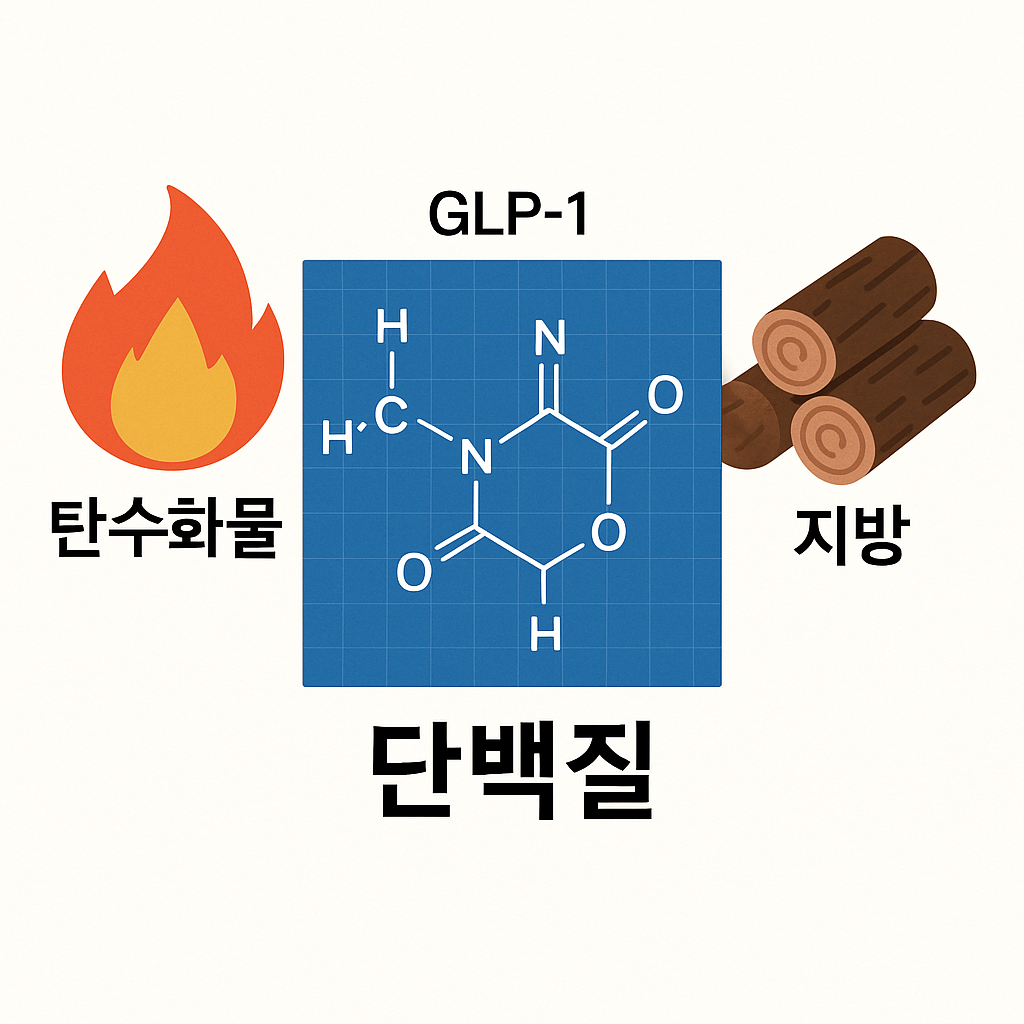
‘단백질’이라는 말을 들으면, 우리는 흔히 근육을 먼저 떠올립니다.
하지만 단백질은 단순히 근육을 만드는 재료에 그치지 않습니다.
세포 하나하나의 골격,
면역계의 감시자(항체),
뇌의 정보 전달자(신경전달물질 수용체 등),
그리고 호르몬과 효소처럼 생체 기능을 조절하는 주요 물질들 대부분이
바로 단백질로 이루어져 있습니다.
최근 비만 치료제로 주목받는 세마글루타이드(위고비) 역시,
사실은 인체 내 단백질에서 유래한 **펩타이드 기반 약물(GLP-1 유사체)**입니다.
이처럼 단백질은 몸속 모든 생명 시스템의 중심에 있으며,
단 하나라도 부족하면 생명 유지가 위태로울 수 있습니다.
(펩타이드에 관한 설명은 별도의 장에서 진행하도록 하겠습니다.)
단백질은 반드시 음식으로부터 섭취해야 하는 필수 성분이지만,
탄수화물이나 지방처럼 몸에 대량으로 저장되지 않습니다.
즉, 공급이 끊기면 몸은 즉각적으로 생체 기능의 저하를 겪게 됩니다.
그러나 지나치게 많이 섭취해도 문제가 생길 수 있습니다.
단백질의 대사 과정에서 생성되는 질소 노폐물은 신장에 부담을 줄 수 있으며,
특히 신장 기능이 약한 사람들은 고단백 식단에 주의가 필요합니다.
그럼에도 불구하고, 우리는 왜 단백질의 본질을 놓치고 있었을까요?
탄수화물과 지방이 ‘연료’라면, 단백질은 ‘설계도와 건축 자재’
탄수화물과 지방은
인체가 저장하고 필요할 때 꺼내 쓰는 ‘연료’입니다.
반면, 단백질은 에너지원이라기보다
**생명 유지와 회복을 위한 ‘설계도이자 건축 자재’**입니다.
왜일까요?
우리 몸은 단백질을 곧바로
근육, 호르몬, 효소, 면역세포, 혈액 단백질 등
핵심 기능과 구조를 구성하는 자원으로 사용하기 때문입니다.
만약 사용되지 않고 남는 단백질이 있다면,
간에서 포도당으로 전환되거나
대사 과정에서 생성된 **질소 노폐물(주로 암모니아)**과 함께 배출됩니다.
즉, 단백질은 저장되지 않는 자원이며,
인체는 이를 그만큼 ‘귀하게’ 사용합니다.
저장되지 않는 생존의 자산
단백질이 저장되지 않기 때문에,
인체는 단백질을 생존의 핵심 자산으로 여기고 마지막까지 아껴 씁니다.
예를 들어,
단식이나 무리한 다이어트에서는
가장 먼저 근육 단백질이 소실됩니다.
심각한 질병이나 노화로 인해 면역 시스템이 약해질 때,
몸은 생존에 더 긴급한 단백질 합성을 위해
근육 단백질을 분해해 아미노산을 확보합니다.
장기 입원 환자나 고령자에서 관찰되는 근육 소실은
예후와 생존율에 직접적인 영향을 줍니다.
이는 단백질, 특히 근육 단백질이
단순한 움직임 이상의 의미를 지닌 생체 회복력의 지표임을 보여줍니다.
이처럼 단백질은
에너지처럼 쉽게 쓰고 버려지는 자원이 아닙니다.
마지막까지 생존을 지탱하다가 서서히 소모되는,
회복에 꼭 필요한 자산입니다.
따라서 체내 단백질이 부족해지면,
근육뿐 아니라 면역력, 사고력, 회복력까지 함께 저하될 수 있습니다.
오늘의 식사, 단백질은 과하거나 부족하지 않았는가?
단백질 섭취는 단순히 ‘무엇을 먹었는가’를 넘어
**‘무엇을, 어떻게, 얼마나, 언제 먹었는가’**가 중요합니다.
아미노산 조성이 불균형한 식품만 섭취했다면?
→ 필수 아미노산이 부족해, 일부 생체 기능이 회복되지 못합니다.
단백질이 이미 변성되었거나,
소화 흡수가 어려운 상태에서 먹었다면?
→ 체내에서 제대로 활용되지 못하고 버려지거나,
소화 불량으로 오히려 불편함을 유발할 수 있습니다.
특히 고령자, 병후 회복기, 소화 기능이 약화된 사람의 경우,
같은 양의 단백질을 섭취해도
체내 흡수율이 낮아지는 경향이 있습니다.
이럴 땐 어떻게 해야 할까요?
→ 필수 아미노산이 풍부하고, 변성이 덜 된, 소화가 잘 되는 형태의 고품질 단백질을
하루 동안 여러 끼니에 나누어 섭취하는 것이 가장 이상적입니다.
이는 아미노산 풀을 안정적으로 유지하고,
근육 단백질 합성을 최적화하는 데 결정적인 역할을 합니다.
(아미노산 풀에 관한 설명은 후에 이어가도록 하겠습니다.)
결론 – 단백질은 불을 피우는 연료가 아니라, 그 불로 만들어야 할 삶의 도구이다
탄수화물은 성냥불입니다.
지방은 장작입니다.
하지만 단백질은
그 불로 지어야 할 삶의 기둥이며, 회복의 도구입니다.
단백질은 인체의 재건 프로젝트 전체를 담당하는 유일한 자원입니다.
한 번 손실되면,
단순한 칼로리 보충으로는 결코 복구되지 않습니다.
탄수화물과 지방이 주인공처럼 보이는 식탁 위에서,
진짜 주인공은
말없이 우리 몸을 지탱해온 단백질일지도 모릅니다.
참고 문헌
1. **Phillips, S. M. (2017).
“Current concepts and unresolved questions in dietary protein requirements and supplements in adults.”
Frontiers in Nutrition, 4, 13.**
→ 이 논문은 성인의 단백질 요구량과 단백질 보충제의 실제 효과에 대해 최신 과학적 관점을 정리하고 있습니다.
논자는 단백질이 근육 유지뿐 아니라 면역, 호르몬, 효소 등 생체 기능 유지에 필수이며,
특히 고령자, 질병 회복기, 활동량이 높은 사람에게는 기초 권장량(RDA)을 초과한 단백질 섭취가 필요하다고 설명합니다.
2. **Wolfe, R. R. (2006).
“The underappreciated role of muscle in health and disease.”
The American Journal of Clinical Nutrition, 84(3), 475–482.**
→ 근육은 단지 움직임을 위한 조직이 아니라 생체 단백질의 주요 저장소이자, 회복과 면역 조절의 핵심이라는 관점을 제시합니다.
질병이나 단식, 노화가 진행되면 근육 단백질이 가장 먼저 소실되고,
이때 아미노산을 공급하기 위한 근육 단백질의 희생은 회복력과 생존율을 좌우한다고 강조합니다.
3. **Volpi, E., Campbell, W. W., Dwyer, J. T., Johnson, M. A., Jensen, G. L., Morley, J. E., & Wolfe, R. R. (2013).
“Is the optimal level of protein intake for older adults greater than the recommended dietary allowance?”
The Journals of Gerontology: Series A, 68(6), 677–681.**→ 이 논문은 노인의 단백질 필요량이 현재의 권장 섭취량(RDA)보다 더 높아야 한다는 증거를 제시합니다.
특히 건강한 노인의 경우 1.0–1.2g/kg/일,
급성 또는 만성 질환이 있는 노인의 경우 1.2–1.5g/kg/일 이상의 단백질 섭취가 회복에 필요하다고 설명하며,
이는 근감소증 예방과 면역 기능 유지를 위한 전략으로 제시하고 있습니다.
또한, 섭취 시기와 흡수 가능성, 소화력 저하에 따른 활용률 감소 등도 함께 고려할 것을 권장합니다.
※ 보충 각주:
이 논문은 단백질의 필요량과 활용도에 대한 생리적 기반을 잘 설명하고 있지만,
단백질의 공급원이 어떤 방식으로 생산되었는지—예를 들어 공장식 축산물, 항생제 잔류, GMO 식물 기반 단백질, 글리포세이트 노출 여부 등—에 대한 고려는 포함되어 있지 않습니다.
이는 2013년 당시에는 상대적으로 간과되던 주제였으며,
최근에는 단백질의 영양학적 질 못지않게 환경적·독성학적 안전성과 윤리성까지 고려하는 접근이 요구되고 있습니다.
향후 연구에서는 단백질의 아미노산 조성과 소화율뿐 아니라,
그 단백질이 어떤 방식으로 자라고, 어떻게 가공되었는지를 함께 분석하는 다층적 프레임이 필요합니다.
4. **Leidy, H. J., Clifton, P. M., Astrup, A., Wycherley, T. P., Westerterp-Plantenga, M. S., Luscombe-Marsh, N. D., … & Mattes, R. D. (2015).
“The role of protein in weight loss and maintenance.”
The American Journal of Clinical Nutrition, 101(6), 1320S–1329S.**
→ 단백질은 체중 감량뿐 아니라 체중 유지와 요요 방지, 대사 회복에 핵심적인 역할을 한다는 리뷰 논문입니다.
GLP-1 분비를 촉진하는 고단백 식사는 포만감과 혈당 조절에 효과적이며,
식사 시기 분산 섭취가 단백질 합성과 근육 유지에 더 효과적이라는 점을 강조합니다.
5. **Knudsen, L. B., & Lau, J. (2019).
“The discovery and development of liraglutide and semaglutide.”
Frontiers in Endocrinology, 10, 155.**
→ **세마글루타이드(위고비)와 리라글루타이드(삭센다)**의 분자적 구조와 생체 작용을 소개한 논문입니다.
이 약물들은 GLP-1이라는 내인성 단백질에서 유래된 펩타이드 기반 약물이며,
식욕 억제, 위 배출 지연, 인슐린 분비 촉진을 통해 대사질환 치료에 활용됩니다.
이로써 단백질이 단순한 근육 구성 요소를 넘어 호르몬과 치료제의 기반이 된다는 사실을 보여줍니다.
English Version
Protein: A Familiar Term, But an Unfamiliar Reality
When we hear the word protein, we often think of muscles.
But protein is far more than just a building block for muscle mass.
The skeleton of every cell, the vigilant agents of our immune system (antibodies),
the signal receptors in the brain (neurotransmitter receptors),
and the majority of hormones and enzymes that regulate our biological functions—
all are composed of proteins.
Even semaglutide (Wegovy), a drug gaining attention for obesity treatment,
is a peptide-based medication derived from the human protein GLP-1.
This illustrates how central proteins are to nearly every biological system,
and how a lack of even one can jeopardize life itself.
(A separate chapter will cover the role of peptides.)
Protein must be consumed from food,
yet unlike carbohydrates and fats, it cannot be stored in large quantities in the body.
A disrupted supply leads to immediate biological deterioration.
That said, excessive intake can also be harmful.
During metabolism, nitrogenous waste is produced,
which can place a burden on the kidneys.
People with impaired kidney function should be particularly cautious with high-protein diets.
So why have we overlooked the true nature of protein for so long?
If Carbohydrates and Fat Are Fuel, Then Protein Is the Blueprint and Building Material
Carbohydrates and fat are fuel—stored in the body and burned when needed.
Protein, on the other hand, is not primarily an energy source.
It is a blueprint and construction material for sustaining and repairing life.
Why?
Because protein is used immediately to form critical components like:
muscles, hormones, enzymes, immune cells, and blood proteins.
If there is any excess, it is converted into glucose in the liver (gluconeogenesis)
or excreted alongside nitrogen waste (mostly ammonia).
Protein is a non-storable resource—and the body uses it accordingly,
only where it’s most needed, and with great care.
A Survival Asset That Cannot Be Stored
Since protein cannot be stored,
the human body treats it as a precious asset of survival, reserved until absolutely necessary.
For example:
During fasting or extreme dieting, muscle protein is the first to be broken down.
In cases of disease or aging, where immune function weakens,
the body catabolizes muscle tissue to retrieve amino acids
for other vital protein synthesis necessary to stay alive.
In elderly or long-term hospitalized patients,
muscle loss directly correlates with outcomes and survival rates.
This proves that protein—especially muscle protein—
is more than just a component of movement;
it is a core indicator of resilience and recovery.
Unlike calories, protein is not easily consumed and discarded.
It is used until the very end—slowly, carefully—
as a resource essential for healing.
And when protein is lacking,
not only do muscles weaken, but immunity, cognition, and recovery capacity all decline.
In Today’s Meal, Was Protein Too Much or Too Little?
Protein intake is not just about what you ate—
but what, how, how much, and when you ate it.
If you only consumed foods with unbalanced amino acid profiles:
→ Essential amino acid deficiency can prevent full biological recovery.
If the protein was already denatured or consumed under poor digestive conditions:
→ It may not be properly absorbed and could cause discomfort.
In older adults, patients in recovery, or those with weakened digestion:
→ Even the same amount of protein leads to reduced absorption and utilization.
So what should be done?
→ Choose high-quality protein—rich in essential amino acids,
minimally denatured, and easy to digest.
→ Spread it out over multiple meals throughout the day.
This helps stabilize the amino acid pool
and optimize muscle protein synthesis.
(More on amino acid pool will follow in a later section.)
Conclusion – Protein Is Not the Fire, but the Tool Forged by It
Carbohydrates are the matchstick.
Fat is the firewood.
But protein is the pillar we build with,
the tool we recover with.
Protein is the only resource that orchestrates the body’s reconstruction projects.
Once lost, it cannot be restored through calories alone.
At a table where carbs and fat seem to play the leading roles,
the silent protagonist may very well be the protein
that has held our bodies together all along.
References (with annotation for #3)
1. Phillips, S. M. (2017).
Current concepts and unresolved questions in dietary protein requirements and supplements in adults.
Frontiers in Nutrition, 4, 13.
→ Reviews optimal protein needs in adults, highlighting the importance of protein for immunity, hormones, and enzymes beyond just muscle maintenance.
2. Wolfe, R. R. (2006).
The underappreciated role of muscle in health and disease.
The American Journal of Clinical Nutrition, 84(3), 475–482.
→ Muscle is a reservoir for protein essential to immune and metabolic recovery; it is rapidly depleted during illness or fasting.
3. Volpi, E., et al. (2013).
Is the optimal level of protein intake for older adults greater than the recommended dietary allowance?
The Journals of Gerontology: Series A, 68(6), 677–681.
→ Proposes protein intake of 1.0–1.2g/kg/day for healthy older adults,
and 1.2–1.5g/kg/day or more for those with illness. Emphasizes protein timing, quality, and digestibility.
Annotation:
This paper does not address the source or production methods of protein—e.g., whether it is from factory-farmed animals, GMO crops, or glyphosate-contaminated grains.
This reflects the research limitations of its time (2013).
Today, the toxicity, sustainability, and ethical concerns of protein sources are receiving growing attention.
Future studies must expand protein quality evaluation to include not just amino acid content and digestibility,
but also how the protein was raised, treated, and processed.
4. Leidy, H. J., et al. (2015).
The role of protein in weight loss and maintenance.
The American Journal of Clinical Nutrition, 101(6), 1320S–1329S.
→ High-protein diets promote satiety and GLP-1 release; protein distribution across meals improves muscle synthesis and metabolic stability.
5. Knudsen, L. B., & Lau, J. (2019).
The discovery and development of liraglutide and semaglutide.
Frontiers in Endocrinology, 10, 155.
→ Details how GLP-1–based peptide drugs like semaglutide were developed from human proteins to regulate insulin and appetite in metabolic disease.
日本語バージョン
タンパク質 ― なじみ深い言葉、でも本質はまだ知られていない
「タンパク質」と聞くと、多くの人がまず筋肉を思い浮かべるでしょう。
しかし、タンパク質は単に筋肉の材料というだけではありません。
細胞一つ一つの骨格、免疫系の監視役(抗体)、
脳内の情報伝達者(神経伝達物質受容体)、
さらにはホルモンや酵素など、生命機能を調整する重要な物質のほとんどが、
タンパク質で構成されています。
近年、肥満治療薬として注目されているセマグルチド(ウィゴビー)も、
実は体内のタンパク質「GLP-1」に由来するペプチドベースの薬剤です。
このように、タンパク質は私たちの生命システムの中心にあり、
そのどれか一つでも不足すれば、生命の維持は危うくなります。
(※ペプチドについては後の章で詳しく解説します。)
タンパク質は、食事から摂取しなければならない必須成分ですが、
炭水化物や脂質のように大量に体内に貯蔵されることはありません。
供給が途絶えると、体はすぐに生体機能の低下を引き起こします。
とはいえ、過剰摂取も問題です。
代謝過程で生じる窒素性老廃物は腎臓に負担をかけるため、
腎機能が低下している人は、高タンパク食に注意が必要です。
それにもかかわらず、私たちはなぜ、タンパク質の本質を見落としてきたのでしょうか?
炭水化物と脂質が「燃料」なら、タンパク質は「設計図と建材」
炭水化物と脂質は、体内に貯蔵され、必要に応じて消費される「エネルギー源」です。
一方で、タンパク質はエネルギーというより、
**生命を維持し、修復するための『設計図』であり『建材』**なのです。
なぜそう言えるのでしょうか?
私たちの体は、タンパク質をすぐに以下のような構成要素に使います:
筋肉、ホルモン、酵素、免疫細胞、血中タンパク質など、
すべてが生命維持に不可欠な機能と構造です。
もし使われずに余ったタンパク質があった場合、
肝臓でブドウ糖に変換されるか、
代謝によって生じた**窒素老廃物(主にアンモニア)**とともに排出されます。
つまり、タンパク質は貯蔵できない資源であり、
体はそれを極めて慎重に、大切に使うのです。
蓄えられない「生存の資産」
タンパク質は貯蔵できないため、
体はこれを**「最後まで守る生存の資産」**として扱います。
たとえば、
断食や無理なダイエットを行うと、
まず最初に筋肉タンパク質が分解されます。
重い病気や高齢化によって免疫機能が低下すると、
体は生存に不可欠なタンパク質合成のために、
筋肉を分解してアミノ酸を取り出します。
長期入院や高齢者で観察される筋肉の減少は、
予後や生存率に直接的な影響を与えるのです。
これは、筋肉タンパク質が単なる運動器官ではなく、
身体の回復力を示す指標であることを意味しています。
タンパク質は、エネルギーのように簡単に消費・排出されるものではありません。
最後まで体を支え、ゆっくりと使い尽くされる、回復に不可欠な資源なのです。
そして体内のタンパク質が不足すると、
筋力だけでなく、免疫力・思考力・回復力までもが一緒に低下していきます。
今日の食事、タンパク質は過不足なかったか?
タンパク質の摂取は、「何を食べたか」だけでなく、
**「何を・どのように・どれだけ・いつ食べたか」**が重要です。
アミノ酸バランスが偏った食品だけを摂った場合:
→ 必須アミノ酸が不足し、生命機能の一部が回復できません。
すでに変性したタンパク質や、消化吸収が困難な状態で摂取した場合:
→ 体内で利用されず、未消化となり、むしろ不快感を招くこともあります。
特に高齢者、病後の回復期、消化機能が低下した方の場合は、
同じ量のタンパク質を摂っても、体内での利用率が低くなる傾向があります。
では、どうすればよいのでしょうか?
→ 必須アミノ酸が豊富で、変性しておらず、消化しやすい良質なタンパク質を、
一日数回に分けて摂取することが理想的です。
これはアミノ酸プールを安定的に保ち、筋肉合成を最適化するために非常に重要です。
(※アミノ酸プールについては後述します。)
結論 ― タンパク質は火ではなく、火で作る「人生の道具」
炭水化物はマッチの火。
脂質は薪のようなもの。
しかしタンパク質は、
その火によって作られる**「人生を支える柱」であり、「回復のための道具」**です。
タンパク質は、体の「再建プロジェクト」全体を担う、唯一の資源です。
一度失われれば、単なるカロリー補給では回復できません。
炭水化物や脂質が主役のように見える食卓の上でも、
本当の主役は、静かに体を支え続けてきたタンパク質かもしれません。
参考文献(※文献3に補足注記あり)
1. Phillips, S. M. (2017).
『Current concepts and unresolved questions in dietary protein requirements and supplements in adults』
Frontiers in Nutrition, 4, 13.
→ タンパク質の免疫・ホルモン・酵素への重要性を強調。特に高齢者や病後回復者には基準を超える摂取が必要。
2. Wolfe, R. R. (2006).
『The underappreciated role of muscle in health and disease』
The American Journal of Clinical Nutrition, 84(3), 475–482.
→ 筋肉は免疫や代謝のためのタンパク質供給源。疾患時には真っ先に消費され、健康予後に影響。
3. Volpi, E., et al. (2013).
『Is the optimal level of protein intake for older adults greater than the recommended dietary allowance?』
The Journals of Gerontology: Series A, 68(6), 677–681.
→ 健康な高齢者には1.0–1.2g/kg/日、疾患のある高齢者には1.2–1.5g/kg/日以上の摂取を推奨。タイミングと質の重要性も強調。
🔹 補足注記:
この研究では、タンパク質の供給源(動物性 or 植物性)や生産方法(工場畜産、GMO作物、農薬残留)に関する記述はない。
2013年当時はこのような視点が一般的ではなかったが、現在では食材の生理的安全性・環境持続性・倫理性が重視されている。
将来の研究では、アミノ酸構成や消化率に加え、「どのように育てられ、加工されたか」というプロセスの分析が必要とされる。
4. Leidy, H. J., et al. (2015).
『The role of protein in weight loss and maintenance』
The American Journal of Clinical Nutrition, 101(6), 1320S–1329S.
→ 高タンパク食はGLP-1分泌を促進し、満腹感と代謝の安定に寄与。食事タイミングの分散も有効。
5. Knudsen, L. B., & Lau, J. (2019).
『The discovery and development of liraglutide and semaglutide』
Frontiers in Endocrinology, 10, 155.
→ GLP-1由来のペプチド薬(例:セマグルチド)の開発過程とその作用機序。インスリン調整と食欲抑制に貢献。
Leave a Reply