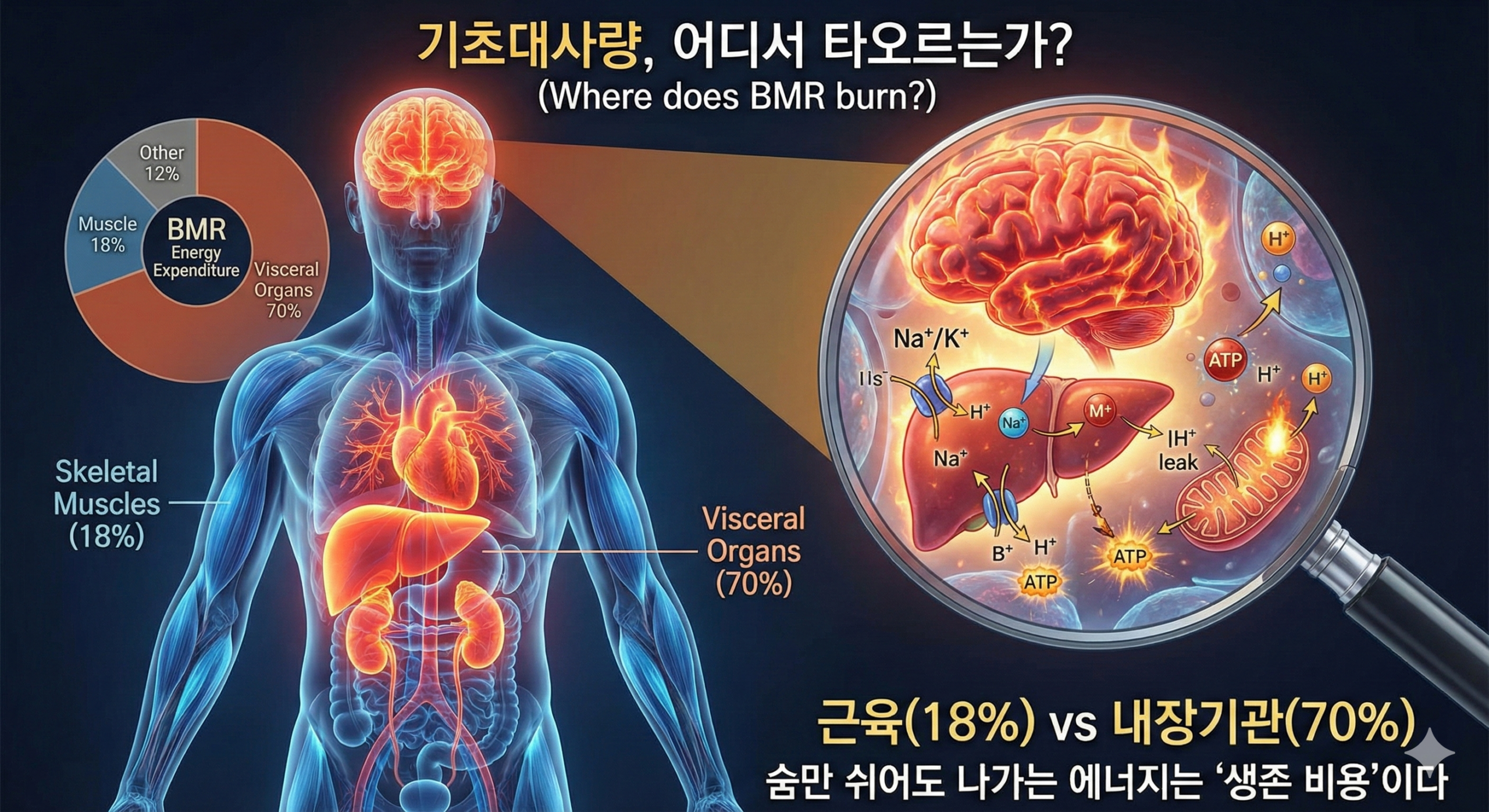
기초대사량(Basal Metabolic Rate, BMR) 이란 무엇일까요?
대중매체에서는 흔히 “숨만 쉬어도 나가는 에너지” 정도로 뭉뚱그리지만, 의학적으로는 *항상성(Homeostasis) 유지를 위한 세포 단위의 최소 에너지 비용으로 정의해야 정확합니다.
대사(Metabolism) 관점에서, BMR의 본질을 *세포 생리학(Cell Physiology)과 *장기별 기여도(Organ Contribution)로 해부하여 설명드립니다.
1. 기초대사량(BMR)의 엄밀한 정의 (Strict Definition)
단순히 ‘쉬고 있을 때’가 아닙니다. 생리학적 측정 조건(Standard Conditions)은 다음과 같습니다.
- Post-absorptive State (흡수 후 상태): 마지막 식사 후 12시간 이상 경과하여, 소화기계의 연동 운동(Peristalsis)과 음식물에 의한 열 효과(TEF)가 완전히 배제된 상태.
- Thermoneutral Environment (중립 온도): 체온 조절을 위해 발한(Sweating)이나 떨림(Shivering)이 필요 없는 온도.
- Physical & Mental Rest: 골격근의 활동이 없고, 교감신경의 흥분이 없는 각성 상태.
이 조건에서 소모되는 에너지는 생명을 유지하는 *기계적, 화학적, 수송적 작업(Work)의 총합입니다.
2. 세포 수준의 에너지 비용 분석 (Where does the ATP go?)
BMR은 결국 세포가 ATP를 어디에 쓰느냐의 문제입니다. 크게 세 가지 기전이 전체 BMR의 약 70~80%를 차지합니다.
A. 막 전위 유지 (Maintenance of Membrane Potential): 약 20~30%
모든 세포, 특히 *신경(Brain)과 근육은 세포막 안팎의 이온 농도 차이를 유지해야 합니다. 이를 위해 *Na+/K+-ATPase (나트륨-칼륨 펌프)가 끊임없이 ATP를 가수분해하며 돌아갑니다.
- 이것이 멈추면 세포는 부종(Swelling)으로 터지거나 신경 전도가 불가능해집니다. 이 ‘전기적 항상성’ 비용이 막대합니다.
B. 미토콘드리아 양성자 누출 (Mitochondrial Proton Leak): 약 20%
미토콘드리아 내막의 전자전달계(ETC)에서 형성된 수소 이온(H+) 기울기가 ATP 합성에 100% 쓰이지 않고, 일부가 UCP(Uncoupling Protein) 등을 통해 새어 나갑니다.
- 이 과정에서 ATP는 생성되지 않고 오직 *열(Heat)만 발생합니다.
- 이것은 비효율처럼 보이지만, 체온 유지를 위한 핵심적인 생화학적 난로(Furnace) 역할을 합니다. 갑상선 호르몬(T3)이 이 과정을 조절합니다.
C. 거대분자 회전 (Macromolecule Turnover): 약 20~30%
- 단백질 합성 및 분해: 효소, 호르몬, 구조 단백질은 수명이 다하면 분해되고 다시 합성됩니다. 펩타이드 결합을 형성하는 데 막대한 ATP가 소모됩니다.
- 당신생(Gluconeogenesis) 및 요소 회로(Urea Cycle): 간에서 일어나는 이 화학적 공정들이 BMR의 상당 부분을 차지합니다.
3. 장기별 기여도 분석 (Organ-Tissue Specific Metabolic Rate)
대중매체나 헬스 트레이너들은 “근육이 많아야 기초대사량이 폭발적으로 늘어난다”고 주장하지만, 장기별 단위 무게당 에너지 소모량을 보면 이는 과장된 면이 있습니다.
| 장기/조직 | 대사율 (kcal/kg/day) | BMR 기여도 (%) | 특징 |
| 간 (Liver) | 약 200 | 27% | 당신생, 단백질 합성, 해독 등 대사의 용광로 |
| 뇌 (Brain) | 약 240 | 19% | Na+/K+ 펌프 가동 (전기 신호 유지) |
| 심장 (Heart) | 약 440 | 7% | 평생 멈추지 않는 물리적 펌핑 |
| 신장 (Kidneys) | 약 440 | 10% | 혈액 여과 및 재흡수 (능동 수송) |
| 골격근 (Muscle) | 약 13 | 18% | 휴식 시에는 대사율이 매우 낮음 |
| 지방 (Adipose) | 약 4.5 | 3% | 에너지 저장고, 대사 활성 낮음 |
- 분석: 간, 뇌, 심장, 신장 등 *내장기관(Visceral Organs)의 무게는 체중의 7%에 불과하지만, BMR의 *약 60~70%를 소모합니다.
- 흔히 하는 오류 수정: 골격근은 무게가 많이 나가서 총합은 크지만, 단위 무게당 효율은 간의 1/15 수준입니다. 따라서 근육 1kg을 늘려도 기초대사량 증가는 약 13kcal 정도에 불과합니다. (물론 운동 시 활동대사량은 폭발적으로 증가하지만, BMR 자체의 증가는 제한적입니다.)
4. 기초대사량 조절의 핵심: 갑상선 호르몬 (Thyroid Hormones)
BMR의 ‘속도 조절 나사’는 *갑상선 호르몬(T3, Triiodothyronine)입니다.
- T3는 세포 핵 내 수용체에 결합하여 Na+/K+-ATPase와 UCP(미토콘드리아 짝풀림 단백질), 그리고 호흡 효소들의 전사(Transcription)를 증가시킵니다.
- 기아 상태나 극단적인 다이어트 시 BMR이 떨어지는 이유는, 에너지 보존을 위해 T3 레벨이 낮아지고 *Reverse T3 (비활성형)가 증가하여 세포의 ‘공회전’을 줄이기 때문입니다.
요약
*기초대사량(BMR)은 단순히 다이어트 계산을 위한 숫자가 아닙니다.
- 세포막의 전위차를 유지하여 신경과 근육을 대기 상태로 놓고 (Na+/K+ Pump),
- 미토콘드리아에서 일부러 에너지를 새게 만들어(Proton Leak) 체온을 유지하며,
- 간과 뇌가 생존을 위해 쉼 없이 거대분자를 재조립하고 독소를 처리하는 과정의 총 에너지 비용입니다.
대중매체가 “근육만 키우면 기초대사량이 기하급수적으로 늘어 살이 안 찐다”고 하는 것은, 내장기관의 압도적인 대사 기여도를 무시한 반쪽짜리 진실입니다.
이를 뒷받침할 세계적으로 공신력을 갖춘 영어권 원서 및 핵심 논문을 덧붙임으로서 , 이 글이 제, 단순한 주장이 아니라, *세계 의학계의 정설(Orthodoxy)에 기반하고 있음을 증명하는 강력한 근거가 될 것이라 확신합니다.
[참고문헌]
- Hall, J. E., & Hall, M. E. (2020).Guyton and Hall Textbook of Medical Physiology (14th ed.). Elsevier.
- (설명: 전 세계 의대생들의 표준 교과서입니다. 세포막 전위 유지를 위한 에너지 비용과 인슐린 분비 기전(아미노산 자극)에 대한 정통 생리학적 근거를 제공합니다.)
- Rolfe, D. F., & Brown, G. C. (1997). “Cellular energy utilization and molecular origin of standard metabolic rate in mammals”. Physiological Reviews, 77(3), 731-758.
- (설명: 기초대사량의 분자적 기원을 규명한 기념비적인 논문입니다. BMR의 약 20%가 미토콘드리아 양성자 누출(Proton Leak)에서, 약 20-25%가 Na+/K+ 펌프에서 발생함을 정량적으로 분석했습니다.)
- Müller, M. J., et al. (2018). “Advances in the understanding of specific metabolic rates of major organs and tissues in humans”. Current Opinion in Clinical Nutrition & Metabolic Care, 21(5), 332-340.
- (설명: 장기별 대사율(Organ-specific metabolic rate)에 대한 최신 연구입니다. 근육보다 간, 뇌, 신장 등 내장기관이 단위 무게당 훨씬 높은 에너지를 소모한다는 팩트를 뒷받침합니다.)
- Boron, W. F., & Boulpaep, E. L. (2016).Medical Physiology (3rd ed.). Elsevier.
- (설명: 세포 생리학 분야에서 가장 권위 있는 심화 교과서 중 하나입니다. 항상성 유지를 위한 세포의 수송 작업(Transport work)과 에너지 대사 과정을 분자 수준에서 상세히 다룹니다.)
- Nelson, D. L., & Cox, M. M. (2017).Lehninger Principles of Biochemistry (7th ed.). W. H. Freeman.
- (설명: 생화학의 바이블입니다. 미토콘드리아의 전자전달계, UCP(짝풀림 단백질)에 의한 열 발생 기전, 그리고 인체의 대사 조절 경로를 명확하게 설명합니다.)
What is Basal Metabolic Rate?
What exactly is Basal Metabolic Rate (BMR)?
While mass media often generalizes it as “energy expended just by breathing,” medically, it is accurately defined as the minimum energy cost at the cellular level for maintaining homeostasis.
From the perspective of metabolism, I report on the essence of BMR by dissecting it through cell physiology and organ contribution.
1. Strict Definition of Basal Metabolic Rate (BMR)
It is not simply “when resting.” The standard physiological measurement conditions are as follows:
- Post-absorptive State: A state where more than 12 hours have passed since the last meal, completely excluding peristalsis of the digestive system and the thermic effect of food (TEF).
- Thermoneutral Environment: A temperature where sweating or shivering is not required for thermoregulation.
- Physical & Mental Rest: A state of wakefulness with no skeletal muscle activity and no sympathetic nervous system excitement.
The energy consumed under these conditions is the sum of mechanical, chemical, and transport work that sustains life.
2. Analysis of Energy Cost at the Cellular Level (Where does the ATP go?)
BMR is ultimately a question of where cells use ATP. Three major mechanisms account for approximately 70-80% of total BMR.
A. Maintenance of Membrane Potential: Approx. 20-30%
All cells, especially nerves (Brain) and muscles, must maintain a difference in ion concentration inside and outside the cell membrane. To achieve this, the Na+/K+-ATPase (Sodium-Potassium Pump) continuously hydrolyzes ATP.
As you are well aware, if this stops, cells will burst due to swelling or nerve conduction will become impossible. This “electrical homeostasis” cost is immense.
B. Mitochondrial Proton Leak: Approx. 20%
The hydrogen ion (H+) gradient formed in the electron transport chain (ETC) of the inner mitochondrial membrane is not 100% used for ATP synthesis; some leaks out through UCP (Uncoupling Protein), etc.
In this process, ATP is not generated, and only heat is produced.
While this may seem inefficient, it acts as a key biochemical furnace for maintaining body temperature. Thyroid hormone (T3) regulates this process.
C. Macromolecule Turnover: Approx. 20-30%
- Protein Synthesis and Degradation: Enzymes, hormones, and structural proteins are degraded and re-synthesized when their lifespan ends. Enormous amounts of ATP are consumed to form peptide bonds.
- Gluconeogenesis and Urea Cycle: These chemical processes occurring in the liver account for a significant portion of BMR.
3. Organ-Tissue Specific Metabolic Rate
Mass media and fitness trainers claim that “having more muscle explosively increases basal metabolic rate,” but looking at energy consumption per unit weight by organ, this is an exaggeration.
| Organ/Tissue | Metabolic Rate (kcal/kg/day) | BMR Contribution (%) | Characteristics |
| Liver | Approx. 200 | 27% | Metabolic furnace for gluconeogenesis, protein synthesis, detoxification, etc. |
| Brain | Approx. 240 | 19% | Operation of Na+/K+ pump (maintenance of electrical signals) |
| Heart | Approx. 440 | 7% | Physical pumping that never stops for a lifetime |
| Kidneys | Approx. 440 | 10% | Blood filtration and reabsorption (active transport) |
| Skeletal Muscle | Approx. 13 | 18% | Metabolic rate is very low at rest |
| Adipose | Approx. 4.5 | 3% | Energy reservoir, low metabolic activity |
- Analysis: The weight of visceral organs such as the liver, brain, heart, and kidneys is only 7% of body weight, but they consume approx. 60-70% of BMR.
- Error Correction: Skeletal muscle has a large total mass, so the total sum is significant, but its efficiency per unit weight is 1/15th that of the liver. Therefore, increasing muscle by 1kg only increases basal metabolic rate by about 13kcal. (Of course, active metabolic rate increases explosively during exercise, but the increase in BMR itself is limited.)
4. The Core of BMR Regulation: Thyroid Hormones
The “speed control screw” of BMR is Thyroid Hormone (T3, Triiodothyronine).
- T3 binds to receptors in the cell nucleus and increases the transcription of Na+/K+-ATPase, UCP (mitochondrial uncoupling protein), and respiratory enzymes.
- The reason BMR drops during starvation or extreme dieting is that T3 levels decrease and Reverse T3 (inactive form) increases to preserve energy, reducing cellular “idling.”
Summary
Basal Metabolic Rate (BMR) is not just a number for diet calculations.
It is the total energy cost of:
- Maintaining the potential difference of cell membranes to put nerves and muscles in a standby state (Na+/K+ Pump),
- Intentionally leaking energy in mitochondria (Proton Leak) to maintain body temperature,
- And the continuous reassembly of macromolecules and processing of toxins by the liver and brain for survival.
The mass media claim that “simply building muscle increases basal metabolic rate exponentially so you won’t gain weight” is a half-truth that ignores the overwhelming metabolic contribution of visceral organs.
References (Korean)
- Kim, H. G., et al. (2018). Physiology: An Integrated Approach. 8th ed. Lifescience. (This book explains in detail the physiological definition of basal metabolic rate, measurement conditions, and cellular-level energy costs, especially the Na+/K+ pump and protein synthesis. It is a widely used textbook in medicine and related departments, alongside Guyton and Hall’s Textbook of Medical Physiology.)
- Park, T. S. (2019). Exercise and Energy Metabolism. Hanmi Medical. (This book deals with energy metabolism from the perspective of exercise physiology but provides specific data on BMR components and organ-specific metabolic rates. It is a good resource for comparing energy consumption between muscles and visceral organs.)
- Korean Society for the Study of Obesity. (2022). Guidelines for Obesity Treatment. 8th ed. The Korean Doctors’ Weekly. (It covers the clinical importance of basal metabolic rate in relation to obesity treatment, changes in basal metabolic rate during dieting, and the role of thyroid hormones. It helps in understanding BMR from a clinical medical perspective.)
- Kang, B. C. (2015). Clinical Nutrition. 3rd ed. Kyomunsa. (It details methods for measuring and calculating basal metabolic rate from a nutritional perspective, as well as influencing factors. It is useful for clarifying the difference between the thermic effect of food (TEF) and basal metabolic rate.)
- Lee, J. H. (2020). Human Metabolic Biochemistry. 2nd ed. Bioscience. (It deals with energy metabolism at the cellular level, mitochondrial function, the role of proton leak and UCP, and hormonal action as a metabolic regulation mechanism in depth biochemically.)
基礎代謝量とは?
基礎代謝量(Basal Metabolic Rate, BMR)とは一体何でしょうか?
マスメディアではよく「息をするだけで消費されるエネルギー」程度に大雑把に語られますが、医学的には恒常性(Homeostasis)維持のための細胞レベルでの最小エネルギーコストと定義するのが正確です。
代謝(Metabolism)の観点から、BMRの本質を**細胞生理学(Cell Physiology)と臓器別寄与度(Organ Contribution)**で解剖してご報告いたします。
1. 基礎代謝量(BMR)の厳密な定義(Strict Definition)
単に「休んでいる時」ではありません。生理学的な測定条件(Standard Conditions)は以下の通りです。
- 吸収後状態(Post-absorptive State): 最後の食事から12時間以上経過し、消化器系の蠕動運動(Peristalsis)と食事誘発性熱産生(TEF)が完全に排除された状態。
- 中性温度環境(Thermoneutral Environment): 体温調節のために発汗(Sweating)や震え(Shivering)を必要としない温度。
- 身体的・精神的安静(Physical & Mental Rest): 骨格筋の活動がなく、交感神経の興奮がない覚醒状態。
この条件で消費されるエネルギーは、生命を維持する**機械的、化学的、輸送的作業(Work)**の総和です。
2. 細胞レベルのエネルギーコスト分析(Where does the ATP go?)
BMRは結局、細胞がATPをどこに使っているかという問題です。大きく3つの機序が全BMRの約70〜80%を占めます。
A. 膜電位維持(Maintenance of Membrane Potential):約20〜30%
すべての細胞、特に**神経(Brain)**と筋肉は、細胞膜内外のイオン濃度差を維持しなければなりません。このために、 **Na+/K+-ATPase(ナトリウム-カリウムポンプ)**が絶えずATPを加水分解しながら稼働しています。
これが止まれば細胞は浮腫(Swelling)で破裂したり、神経伝導が不可能になります。この「電気的恒常性」のコストは莫大です。
B. ミトコンドリアのプロトン漏出(Mitochondrial Proton Leak):約20%
ミトコンドリア内膜の電子伝達系(ETC)で形成された水素イオン(H+)勾配がATP合成に100%使われず、一部がUCP(Uncoupling Protein、脱共役タンパク質)などを通じて漏れ出します。
この過程ではATPは生成されず、ただ**熱(Heat)**だけが発生します。
これは非効率に見えますが、体温維持のための核心的な生化学的暖炉(Furnace)の役割を果たします。甲状腺ホルモン(T3)がこの過程を調節します。
C. 高分子の代謝回転(Macromolecule Turnover):約20〜30%
- タンパク質の合成および分解: 酵素、ホルモン、構造タンパク質は寿命が尽きると分解され、再び合成されます。ペプチド結合を形成するのに莫大なATPが消費されます。
- 糖新生(Gluconeogenesis)および尿素回路(Urea Cycle): 肝臓で起こるこれらの化学的工程がBMRのかなりの部分を占めます。
3. 臓器別寄与度分析(Organ-Tissue Specific Metabolic Rate)
マスメディアやフィットネストレーナーは「筋肉が多ければ基礎代謝量が爆発的に増える」と主張しますが、臓器別単位重量当たりのエネルギー消費量を見ると、これは誇張された面があります。
| 臓器/組織 | 代謝率 (kcal/kg/day) | BMR寄与度 (%) | 特徴 |
| 肝臓 (Liver) | 約 200 | 27% | 糖新生、タンパク質合成、解毒など代謝の溶鉱炉 |
| 脳 (Brain) | 約 240 | 19% | Na+/K+ポンプ稼働(電気信号維持) |
| 心臓 (Heart) | 約 440 | 7% | 一生止まらない物理的ポンピング |
| 腎臓 (Kidneys) | 約 440 | 10% | 血液濾過および再吸収(能動輸送) |
| 骨格筋 (Muscle) | 約 13 | 18% | 安静時には代謝率が非常に低い |
| 脂肪 (Adipose) | 約 4.5 | 3% | エネルギー貯蔵庫、代謝活性低い |
- 分析: 肝臓、脳、心臓、腎臓などの**内臓器官(Visceral Organs)の重量は体重の7%に過ぎませんが、BMRの約60〜70%**を消費します。
- 誤謬修正: 骨格筋は重量があるため総和は大きいですが、単位重量当たりの効率は肝臓の1/15レベルです。したがって、筋肉を1kg増やしても基礎代謝量の増加は約13kcal程度に過ぎません。(もちろん運動時の活動代謝量は爆発的に増加しますが、BMR自体の増加は限定的です。)
4. 基礎代謝量調節の核心:甲状腺ホルモン(Thyroid Hormones)
BMRの「速度調節ネジ」は**甲状腺ホルモン(T3, Triiodothyronine)**です。
- T3は細胞核内の受容体に結合し、Na+/K+-ATPaseやUCP(ミトコンドリア脱共役タンパク質)、そして呼吸酵素たちの転写(Transcription)を増加させます。
- 飢餓状態や極端なダイエット時にBMRが低下する理由は、エネルギー保存のためにT3レベルが低下し、**Reverse T3(不活性型)**が増加して細胞の「空回り」を減らすためです。
要約
**基礎代謝量(BMR)**は単にダイエット計算のための数字ではありません。
細胞膜の電位差を維持して神経と筋肉を待機状態にし(Na+/K+ Pump)、
ミトコンドリアであえてエネルギーを漏らして(Proton Leak)体温を維持し、
肝臓と脳が生存のために休むことなく高分子を再組み立てし、毒素を処理する過程の総エネルギーコストです。
マスメディアが「筋肉さえ鍛えれば基礎代謝量が幾何級数的に増えて太らない」と言うのは、内臓器官の圧倒的な代謝寄与度を無視した半分の真実です。
参考文献(韓国語文献の日本語訳)
- キム・ヒョンギュン他 (2018). 生理学:統合的アプローチ. 第8版. ライフサイエンス. (本書は基礎代謝量の生理学的定義、測定条件、細胞レベルのエネルギーコスト、特にNa+/K+ポンプとタンパク質合成について詳しく説明しています。Guyton and Hallの生理学教科書と共に、医学および関連学科で広く使用されている教材です。)
- パク・テソプ (2019). 運動とエネルギー代謝. ハンミ医学. (本書は運動生理学的観点からエネルギー代謝を扱っていますが、基礎代謝量の構成要素と臓器別代謝率に関する具体的なデータを提供しています。特に筋肉と内臓器官のエネルギー消費比較のための良い資料です。)
- 大韓肥満学会 (2022). 肥満治療指針. 第8版. 青年医師. (肥満治療に関連して基礎代謝量の臨床的重要性、ダイエット時の基礎代謝量の変化、甲状腺ホルモンの役割などを扱っています。臨床医学的観点からBMRを理解するのに役立ちます。)
- カン・ビョンチョル (2015). 臨床栄養学. 第3版. 教文社. (栄養学的観点から基礎代謝量を測定し算出する方法、そして影響を与える要因について詳細に記述しています。食事誘発性熱産生(TEF)と基礎代謝量の違いを明確にするのに有用です。)
- イ・ジョンホ (2020). 人体代謝生化学. 第2版. バイオサイエンス. (細胞レベルでのエネルギー代謝、ミトコンドリアの機能、プロトン漏出とUCPの役割、そして代謝調節機序としてのホルモン作用などを生化学的に深く扱っています。)
Leave a Reply